Our minister of science continues to argue that his unwillingness to endorse the theory of evolution is not relevant to science policy. As quoted by the Globe and Mail:
My view isn’t important. My personal beliefs are not important.
I find this amazing. How can the minister of science’s views on the fundamental unifying theory of biology not be important?
I don’t expect him to understand the details of evolutionary theory or to have all of his personal beliefs vetted and religious views muted. However, I do expect him – as minister – to champion and support Canadian science, especially basic research. When our minister refuses to acknowledge the fundamental discoveries of science, our reputation is diminished.
There is also a legitimate – though rather exaggerated – concern that the minister’s views on the truth can influence policy and funding decisions. The funding councils are more than sufficiently independent to prevent any undue ministerial influence here. The real problem is an apparent distrust or lack of interest in basic research from the federal government.
If only there were some institution that had a reputation for journalistic integrity that had a staff of trained editors and a growing audience arriving at its web site every day seeking quality information. If only… Of course, we have thousands of these institutions. They’re called newspapers.
Canada says it has legal obligation to prevent Abdelrazik from travelling: Other terrorism suspects have returne.. theglobeandmail.com/servlet…
This has to stop. Abdelrazik is a Canadian citizen and should be allowed to return. I don’t understand what the Canadian Government is trying to accomplish here.
His main point is certainly right: we can’t have the many benefits of energy without consequence and the National Geographic neglected to show these benefits. However, I do think that Canadians need to be aware of the trade-offs we are making and mitigate – to the extent possible – threats to our environment. For most of us, energy just appears when we flip a switch or drive to the gas station.
I think the tar sands are an important Canadian resource and with careful stewardship their benefits could far exceed their costs. However, my sense is that current policies are not focussed on stewardship and we risk squandering the opportunities provided by the tar sands.
But here’s a surprise for Stephen Harper. We’re calling your bluff. This time we’re telling Ottawa: not so fast. Lots of Canadians are prepared to risk prosecution and defy the ban on funding Abdelrazik. Through an explicit civil disobedience project called Operation Fly Home, spearheaded by Mary Foster in Montreal, a first group of 115 Canadians have so far donated small sums to buy his air ticket home. All of us are making our names and addresses public, so the Mounties won’t have trouble finding us. Our crime? Paying $20 dollars or so to bring home a stranded fellow Canadian whose only crime is his name and religion.
“Operation Fly Home” is a great initiative in response to this bizarre government behaviour.
Fatal Distraction: Forgetting a Child in the Backseat of a Car Is a Horrifying Mistake. Is It a Crime? Gene Weingarten Reports.
“Death by hyperthermia” is the official designation. When it happens to young children, the facts are often the same: An otherwise loving and attentive parent one day gets busy, or distracted, or upset, or confused by a change in his or her daily routine, and just… forgets a child is in the car. It happens that way somewhere in the United States 15 to 25 times a year, parceled out through the spring, summer and early fall. The season is almost upon us.
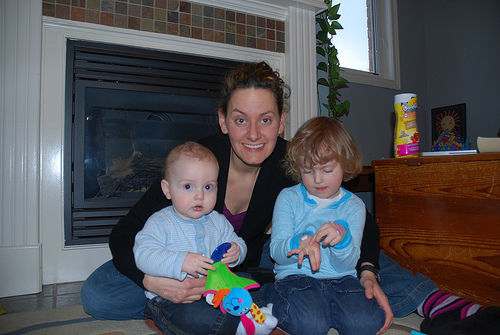
A rare shot of Kelly with both kids. If only we could get Owen and Emma to look at the camera simultaneously.
Sure, science isn’t that exciting. It tends to offer up steady, incremental bits of knowledge rather than miraculous cures, and there remain a lot of unknowns. But these voids need not be filled with fantasy and snake oil.
And, yes, Big Pharma and big business have had their scandals and excesses, but these have been exposed and denounced by the so-called establishment, and they do not negate the good.
Over time, there has emerged from this “vast conspiracy” pretty good health care.
Daring Fireball: Observations, Complaints, Quibbles, and Suggestions Regarding the Safari 4 Public Beta Released One Week Ago, Roughly in Order of Importance
A great example of why I read Daring Fireball: strongly held and insightful opinions, backed by tremendous research and detail.
My plea to all Internet commentators is to at least step up to a certain level of wit and discourse when you publicly disagree, and to challenge the source of your own anger before you spew it at someone else.
But I don’t think that is going too happen any time soon. People out there are having way too much fun to stop the hate.
If you’ve ever played ‘Chinese whispers’, what comes out the end is usually gibberish, and more or less when we speak to each other we’re playing this massive game of Chinese whispers. Yet our language can somehow retain its fidelity.
Death
Sentences
by Don Watson is a wonderful book – simultaneously funny, scary, and
inspiring – that describes how “clichés, weasel words, and
management-speak” are infecting public language.
The humour comes from Watson’s acerbic commentary and fantastic scorn
for phrases like:
Given the within year and budget time flexibility accorded to the
science agencies in the determination of resource allocation from
within their global budget, a multi-parameter approach to
maintaining the agencies budgets in real terms is not appropriate.
The book is scary because it makes a strong argument for the dangers
of this type of language. Citizens become confused and disinterested,
customers become jaded, and people loose their love for language.
Also, as a public servant I see this kind of language every day and
often find myself struggling to avoid banality and cliches (not to
mention bullet points). We need more forceful advocates like Don
Watson to call out politicians and corporations for abusing our
language. This book certainly makes me want to try harder. And
what’s more inspiring than struggling for a good cause against long
odds?
The book also has a great glossary of typical weasel words with possible synonyms. So, I’m keeping the book in my office for quick reference.
In finance, you can never reduce risk outright; you can only try to set up a market in which people who don’t want risk sell it to those who do. But in the CDO market, people used the Gaussian copula model to convince themselves they didn’t have any risk at all, when in fact they just didn’t have any risk 99 percent of the time. The other 1 percent of the time they blew up. Those explosions may have been rare, but they could destroy all previous gains, and then some.
After seventeen years as a vegetarian, I recently switched back to an
omnivore. My motivation for not eating meat was environmental, since,
on average, a vegetarian diet requires much less land, water, and
energy. This is still the right motivation, but over the last year or
so I’ve been rethinking my decision to not eat meat.
My concern was that I’d stopped paying attention to my food choices
and a poorly considered vegetarian diet can easily yield a bad
environmental outcome. In particular, modern agriculture now takes
10 calories of fossil fuel energy to produce a single calorie of
food. This is clearly unsustainable. We cannot rely on
non-renewable, polluting resources for our food, nor can we continue
to transport food great distances – even if it is only vegetables.
My unexamined commitment to a vegetarian diet was no longer consistent
with environmental sustainability.
I think the solution is to eat local, organic food. This also
requires eating seasonal food, but Canadian winters are horrible for
local vegetables. This left me wanting to support local agriculture,
but unable to restrict my diet. Returning to my original motivation
to choose environmentally appropriate food convinced me it was time to
return to being an omnivore. My new policy is to follow Michael
Pollan’s advice: “Eat food. Mostly plants. Not too much.” In
addition, I’ll favour locally grown, organic food and include small
amounts of meat – which I hope will predominantly come from carefully
considered and sustainable sources. I’ve also deciced that when faced
with a dillema of choosing either local or organic, I’ll choose local.
We need to support local agriculture and I’ll trade this for organic
if necessary. Of course, in the majority of cases local and organic
options are available, and I’ll choose them.
This is a big change and I look forward to exploring food again.
The first rule of reading a federal budget is this: When a round number such as $1-billion appears, it means the government (a) picked the number from the air, (b) doesn’t know how or where the money will be spent, or (c) doesn’t have a process for making that decision. A round number, especially a big one, means the government is flying blind.
The best readers are obstinate. They possess a nearly inexhaustible persistence that drives them to read, regardless of the circumstances they find themselves in.
Despite the ubiquity of reading on the web, readers remain a neglected audience. Much of our talk about web design revolves around a sense of movement: users are thought to be finding, searching, skimming, looking.