The new guide to citizenship could be a very interesting read, even for Canadian citizens http://tgam.ca/D8O (via @globeandmail)
The new guide to citizenship could be a very interesting read, even for Canadian citizens http://tgam.ca/D8O (via @globeandmail)
Good to see these detailed analyses of the Federal stimulus money http://tgam.ca/D5b (via @globeandmail)
More commentary on road tolls for Toronto. This warrants serious discussion. http://tgam.ca/D5x (via @globeandmail)
Toll roads are inevitable and likely a good public benefit http://instapaper.com/zmfr7d8k
“Activism disguised as science” on the BPA ban http://tgam.ca/DYf (via @globeandmail)
Canada talks boldly about free trade but does nothing to achieve it http://tgam.ca/DYg (via @globeandmail)
Appreciating the sustainability theme here at the Toronto Forum for Global Cities
RT @aradwanski: Smitherman confirms in our interview that he’s leaving cabinet, running for mayor. http://tinyurl.com/ybsnuxn
We like to think that all great events have great causes, and obviously long-term political, economic and military forces shaped the Cold War – and how it ended. But momentous events are also a sort of ambush of history, when all those long-term pressures come together in an unexpected way. The opening of the Berlin Wall, largely unintentional, was such an event, an unsettling thought for those who see history as the result of strategy and planning by pivotal leaders.
Mary Elise Sarotte – How an accident caused the Berlin Wall to come down
This is precisely how the character of a country becomes fundamentally degraded when it becomes a state in permanent war. So continuous are the inhumane and brutal acts of government leaders that the citizens completely lose the capacity for moral outrage and horror. The permanent claims of existential threats from an endless array of enemies means that secrecy is paramount, accountability is deemed a luxury, and National Security trumps every other consideration – even including basic liberties and the rule of law. Worst of all, the President takes on the attributes of a protector-deity who can and must never be questioned lest we prevent him from keeping us safe.
A court decision that reflects what type of country the U.S. is
It rarely matters who is on your side; what matters is who is against you. Unlike Gloria Loring, you don’t need a friend and you don’t need a lover. What you need is a) one quality nemesis, and b) one archenemy. These are the two most important characters in the life of any successful human
Most Canadians probably fall into a middle group. They’re sensible people who don’t like being sick, care for each other and take reasonable precautions to protect themselves and others. They have a sense of their good fortune in living in the 21st century and a sense of proportion about their priorities. When our health is at risk, we pay attention to our doctors and take our medicines and our vaccines. Then we get on with the important things of life, which centuries of progress and dedicated public health professionals have made it possible for us to enjoy.
Fear’s old struggle with vaccination - The Globe and Mail (via Instapaper)
Now, people waiting in queues will be questioned about why they are there - their likely response being that the health authorities have for months urged them to be there and indeed initially opened clinics to all. If they don’t fall into one of the risk groups, they will be weeded out. The Public Health Agency of Canada, and other health authorities, along with their political masters, should not be surprised by the resulting public fury.
Looking back over human history, rationality has been the anomaly. Being rational takes work, education, and a sober determination to avoid making hasty inferences, even when they appear to make perfect sense. Much like infectious diseases themselves — beaten back by decades of effort to vaccinate the populace — the irrational lingers just below the surface, waiting for us to let down our guard.
Wired: ‘An Epidemic of Fear: How Panicked Parents Skipping Shots Endangers Us All’ (via Instapaper)
A vast majority of professionals are in “emergency scanning” mode. Their self-management consists of checking for and acting on the loudest immediacies – in email, in the hallways and on the phone. Everything else is shoved to the side of the desk, and to the back of their mind. Because they’re focused only on “priorities”, and are paying attention only to the most intheir- face stuff, everyone else has to raise the noise level to “emergency” mode to get any audience at all. Sensitivity and responsiveness to input are criteria for the evolution of a species; and many an organisation has a nervous system that keeps them low on the food chain.
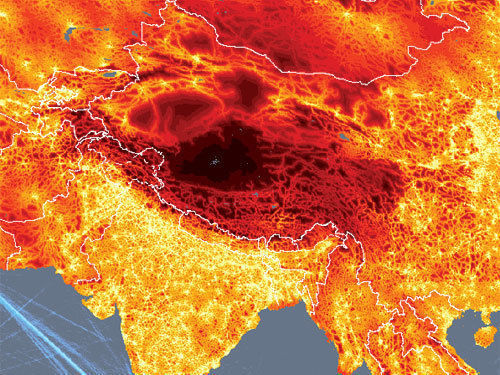
Where’s the remotest place on Earth? - New Scientist: Fantastic image and an interesting research project.
200 years ago, economists made a prediction, and we got it wrong. “Big deal” you might say. But it was a big deal; a much bigger deal than some piddling mistake like failing to predict a global financial crisis. Basically, 200 years ago economists predicted that long run growth was impossible. That’s the biggest thing in economics you can be wrong about.
Worthwhile Canadian Initiative: Economic growth, the universe, and the meaning of life
While good design practices are valuable, the fact remains that every design decision we make is a guess.
Designing the User Experience at Autodesk: Design Values: Validated Data over Expert Opinion
Better Place envisages a convenient network of charging outlets and battery-swap stations that will be tied together with software that makes it possible for both the system and EV drivers to know in real time the ongoing battery range and charge level. Drivers will be able to call up the nearest battery switching or charging station in a display. Thus, they can plan their route and EV range anxiety will be eliminated.
Electric vehicles the ‘rational choice’ - The Globe and Mail
The committee’s diagnosis was stark: the market, left to its own devices, is failing to deliver. Consumers are not buying energy-efficient appliances or insulating their houses, carmakers are failing to get emissions down and power companies still prefer fossil fuels to greener alternatives.
Energy and climate change: Questioning the invisible hand | The Economist