Discussions about transit often end up about funding. To help make these discussions productive, I was pleased to co-author a paper through the Transportation Association of Canada titled Importance of Transportation Funding: Framing the Issues.
Transportation funding is becoming an important topic of discussion at all levels of Transportation Association of Canada (TAC) councils and committees, reflecting discussions that are taking place throughout the Canadian transportation community. The fundamental needs are to maintain and upgrade the country’s aging transportation system while adding new infrastructure to meet the demands of a growing population and economy. These needs are evolving in the face of new challenges, notably changing funding sources and priorities, climate change impacts on infrastructure resiliency, changes to how the system is used, and accommodating new transportation and communications technologies. These challenges have become sharper with the COVID-19 pandemic-induced disruptions in how people and goods move and in shifts in revenues and funding priorities. These needs and challenges cover a broad range. They vary across the country, by mode, ownership, responsibility and more. All told, these complexities mean that the needs and challenges are not fully understood. This briefing describes and categorizes these key challenges and opportunities and provides an initial, high-level assessment of the broader range of potential funding sources, approaches and needs. From this review, the briefing identifies knowledge gaps and potential research directions for consideration by the TAC Transportation Finance Committee and other committees and councils to address these gaps.
Prior to general release, plantae is moving web hosts. This seems like a good time to point out that all of plantae’s code is hosted at Google Code. The project has great potential and deserves consistent attention. Unfortunately, I can’t continue to develop the code. So, if you have an interest in collaborative software, particularly in the scientific context, I encourage you to take a look.
Some technical issues coupled with my road-trip-without-a-laptop conspired to keep Plantae from working correctly. I’ve repaired the damage and isolated Plantae from such problems in the future. My apologies for the downtime.
Hermaphroditism is prevalent in plants but may allow interference between male function (pollen removal and dispersal) and female function (pollen receipt and seed production) within a flower. Temporal or spatial segregation of gender within a hermaphroditic flower may evolve to reduce this interference and enhance male and female reproductive success. We tested this hypothesis using Chamerion angustifolium (Onagraceae), in which pollen removal (male) and pollen deposition (female) were measured directly on hermaphroditic and experimentally produced unisexual flowers. During a single flower visit in the field, bees deposited 159±24 (SE) pollen grains on a stigma and removed 1058±198 grains from each flower. Anther removal did not alter deposition rates. In the laboratory, bees removed 2669±273 pollen grains and deposited 209±72.3 cross-pollen and 120±28.4 facilitated self-pollen grains per visit. The presence of anthers significantly reduced cross-pollen deposition on the stigma. In contrast, pollen removal was not affected by presence of the pistil. These results suggest that within-flower interference affects female function and represents a fitness cost that can be reduced through temporal segregation of gender within the flower.
This book of about 600 pages is written to provide practitioners of pollination biology with a broadly based source of methodologies as well as the basic conceptual background to aid in understanding. Thus, the book reflects the expertise of the assembled a team of internationally acclaimed scientists. Pollination biology enjoys over 200 years of scientific tradition. In recent years, the interdisciplinarity of pollination biology has become a model for integrating physics, chemistry, and biology into natural history, evolutionary and applied ecology. Pollination biology has developed its own techniques and approaches while incorporating ideas, methods, and technology from many facets of pure and applied science.
Protandry, a form of temporal separation of gender within hermaphroditic flowers, may reduce the magnitude of pollen lost to selfing (pollen discounting) and also serve to enhance pollen export and outcross siring success. Because pollen discounting is strongest when selfing occurs between flowers on the same plant, the advantage of protandry may be greatest in plants with large floral displays. We tested this hypothesis with enclosed, artificial populations of Chamerion angustifolium (Onagraceae) by experimentally manipulating protandry (producing uniformly adichogamous or mixed protandrous and adichogamous populations) and inflorescence size (two-, six-, or 10-flowered inflorescences) and measuring pollinator visitation, seed set, female outcrossing rate, and outcross siring success. Bees spent more time foraging on and visited more flowers of larger inflorescences than small. Female outcrossing rates did not vary among inflorescence size treatments. However, seed set per fruit decreased with increasing inflorescence size, likely as a result of increased abortion of selfed embryos, perhaps obscuring the magnitude of geitonogamous selfing. Protandrous plants had a marginally higher female outcrossing rate than adichogamous plants, but similar seed set. More importantly, protandrous plants had, on average, a twofold siring advantage relative to adichogamous plants. However, this siring advantage did not increase linearly with inflorescence size, suggesting that protandry acts to enhance siring success, but not exclusively by reducing between-flower interference.
In self-compatible plants, small populations may experience reduced outcrossing owing to decreased pollinator visitation and mate availability. We examined the relation between outcrossing and population size in eastern Ontario populations of Aquilegia canadensis. Experimental pollinations showed that the species is highly self-compatible, and can achieve full seed-set in the absence of pollinators via automatic self-pollination. We estimated levels of outcrossing (t) and parental inbreeding coefficients (F) from allozyme variation in naturally pollinated seed families for 10 populations ranging in size from 32 to 750 reproductive individuals. The proportion of seeds produced through outcrossing was generally low (mean = 0.29 +/- 0.02 SE) and varied widely among populations (range = 0.00-0.83). Accordingly, estimates of F were large (mean = 0.26 +/- 0.05) and significantly greater than zero in seven populations. As expected, four small populations (N < 40) outcrossed less (0.17 +/- 0.03) than six large populations (N > 90; 0.38 +/- 0. 03). However, parental plants were not significantly more inbred in small than large populations (P = 0.18). There was no difference in the germination of seeds from hand self- and cross-pollinations. However, population genetic estimates of inbreeding depression for survival expressed from seed to reproductive maturity were very high (mean delta = 1 - relative fitness of selfed seed = 0.88 +/- 0.14). The combination of self-compatibility and automatic self-pollination makes the mating system of A. canadensis sensitive to variation in ecological factors that affect the likelihood of cross-pollination.
Historically, dichogamy (the temporal separation of gender in flowering plants) has been interpreted as a mechanism for avoiding inbreeding. However, a comparative survey found that many dichogamous species are self-incompatible (SI), suggesting dichogamy evolved for other reasons, particularly reducing interference between male and female function. Here we re-examined the association between dichogamy and SI in a phylogenetic framework, and tested the hypothesis that dichogamy evolved to reduce interference between male and female function. Using paired comparisons and maximum-likelihood correlation analyses, we find that protandry (male function first) is positively correlated with the presence of SI and protogyny (female function first) with self-compatibility (SC). In addition, estimates of transition-rate parameters suggest strong selection for the evolution of SC in protogynous taxa and a constraint against transitions from protandry to protogyny in SC taxa. We interpret these results as support for protandry evolving to reduce interference and protogyny to reduce inbreeding.
Clonal growth in plants can increase pollen and ovule production per genet. However, paternal and maternal reproductive success may not increase because within-clone pollination (geitonogamy) can reduce pollen export to adjacent clones (pollen discounting) and pollen import to the central ramets (pollen limitation). We investigated the relationship between clone size and mating success using clones of Malus x domestica at four orchards (blocks of 1–5 rows of trees). For each block, we measured maternal function as fruit and seed set in all rows and paternal function as siring rate in the first row of the adjacent block. Expected relations between reproductive success and clone size were generated from simulations and data on pollen dispersal in this species. Siring rate per clone averaged 70\% and did not increase significantly with block size, consistent with simulations of pollen dispersal under pollen discounting. Simulations also indicated that the ratio of compatible to incompatible pollen received by a tree should decline with increased block size and from the periphery to the centre of blocks. However, no significant reductions in female function were detected among block sizes or within blocks. Our results suggest that paternal function may be more sensitive to the effects of clonality than female function.
Protandry (when male function precedes female) can enhance fitness by reducing selfing and increasing pollen export and outcrossed siring success. However, responses to selection on protandry may be constrained by genetic variation and correlations among floral traits. We examined these potential constraints in protandrous Chamerion angustifolium (Onagraceae) by estimating genetic variation in male-phase duration and associated floral traits using a paternal half-sib design and selection experiment. Narrow-sense heritability of male-phase duration was estimated as 0.23 (SE +- 0.04) and was positively correlated with floral display. The selection experiment shortened male-phase duration 0.8 SD from the parental average of 17.0 h and lengthened it by 2.0 SD. Furthermore, fixed floral longevity caused a negative association between male- and female-phase durations. These results suggest that selection on male-phase duration is not limited by genetic variation. However, changes in male-phase duration may influence pollinators through correlated changes in floral display and reduced opportunities for pollen receipt during female phase.
Mating by outcrossing plants depends on the frequency and quality of interaction between pollen vectors and individual flowers. However, the historical focus of pollination biology on individual flowers (floricentrism) cannot produce a complete understanding of the role of pollination in plant mating, because mating is an aggregate process, which depends on the reproductive outcomes of all of a plant’s flowers. Simultaneous display of multiple flowers in an inflorescence increases a plant’s attractiveness to pollinators, which should generally enhance mating opportunities. However, whenever pollinators visit multiple flowers on an inflorescence, self-pollination among flowers can reduce the pollen available for export to other plants (pollen discounting) and increase the incidence of inbreeding depression for embryos and offspring. Therefore, the size of floral displays that maximizes mating frequency and quality generally balances the benefits of attractiveness against the costs of self-pollination. This balance can shift considerably if different flowers serve female and male functions at one time (sexual segregation) and flowers are arranged in inflorescences so that pollinators visit female flowers before male flowers. However, the effectiveness of sexual segregation depends on the extent to which a particular inflorescence architecture induces consistent movement patterns by pollinators. In general, the consistency of pollinator movement patterns varies with inflorescence architecture and differs between pollinator types. Such variation creates many options for the evolution of the diverse inflorescence characteristics within angiosperms, which can be appreciated only by moving beyond a floricentric perspective of the role of pollination in plant mating.
Pollen and ovules experience diverse fates during pollination, pollen-tube growth, fertilization, and seed development, which govern the male and female potential of flowering plants. This chapter identifies these fates and many of their interactions, and considers their theoretical implications for the evolution of pollen export and the production of selfed and outcrossed seeds. This analysis clarifies the importance of pollen quantity and quality for seed production, including the opportunity for poor pollen quality to cause misidentification of pollen limitation. Our analysis emphasizes the asymmetry of pollen and ovule fates and considers its consequences for reproductive evolution. We also identify ovule limitation as a constraint on seed production, which has paradoxically not been recognized before, but is an implicit assumption of previous theoretical analysis of mating-system evolution. Ovule limitation increases the diversity of possible reproductive policies. In addition to ovule limitation, we consider the implications of pollen and resource limitation for the evolution of self- and cross-fertilization. Resource limitation occurs only if plants produce more ovules than they can mature into seeds, which allows a mixture of selfing and outcrossing to be an optimal mating system in some circumstances. The chance of mixed mating being optimal is eroded by trade-offs between self- and cross-pollination, but they do not alter the optimal combination of selfing and outcrossing, should mixed mating be favoured. Our analysis illustrates the key role played by interactions between genetic and ecological influences on reproductive performance in the evolution of plant reproduction.
Sean Rice’sEvolutionary Theory is an excellent journey through the mathematical foundations of evolutionary biology. The book covers a wide array of theory, including single locus models, drift, Price’s Theorem, game theory, and multilevel selection. Despite the often intense content, the book is written with a great, economical style that is easy to read. More importantly, the consistent presentation of such a broad collection of theory highlights the unifying principles of evolution.
In collaboration with Jana and Steve Vamosi, I have started a new project called Plantae. The goal of this project is to create a community website for the collection of evolutionary and ecological data for plant species. An early prototype of the project is available and we welcome feedback on all aspects of the project.
Although the current implementation is rather rough. I hope to make some rapid progress on the design and function of the site in the new year.
Mating by outcrossing plants depends on the frequency and quality of interaction between pollen vectors and individual flowers. However, the historical focus of pollination biology on individual flowers (floricentrism) cannot produce a complete understanding of the role of pollination in plant mating, because mating is an aggregate process, which depends on the reproductive outcomes of all of a plant’s flowers. Simultaneous display of multiple flowers in an inflorescence increases a plant’s attractiveness to pollinators, which should generally enhance mating opportunities. However, whenever pollinators visit multiple flowers on an inflorescence, self-pollination among flowers can reduce the pollen available for export to other plants (pollen discounting) and increase the incidence of inbreeding depression for embryos and offspring. Therefore, the size of floral displays that maximizes mating frequency and quality generally balances the benefits of attractiveness against the costs of self-pollination. This balance can shift considerably if different flowers serve female and male functions at one time (sexual segregation) and flowers are arranged in inflorescences so that pollinators visit female flowers before male flowers. However, the effectiveness of sexual segregation depends on the extent to which a particular inflorescence architecture induces consistent movement patterns by pollinators. In general, the consistency of pollinator movement patterns varies with inflorescence architecture and differs between pollinator types. Such variation creates many options for the evolution of the diverse inflorescence characteristics within angiosperms, which can be appreciated only by moving beyond a floricentric perspective of the role of pollination in plant mating.
Clonality is very common in flowering plants, but its consequences for sexual reproduction have rarely been explored. While clonal growth can increase the number of flowers a plant produces it may also limit reproductive success through pollen discounting (reduction in pollen exported to adjacent clones) and pollen limitation (failure of outside pollen to reach the centre of a clone). Using clones of domestic apple (Malus x domestica) that ranged from 1 to 5 orchard rows wide, we found that the patterns of siring success were consistent with the presence of pollen discounting, but we failed to detect evidence for pollen limitation. The results suggest that paternal function may be more sensitive to the effects of clonality than female function.
Dichogamy, the temporal separation of gender within a flower, is widespread throughout the angiosperms, occurring in over 250 families. There are two forms of dichogamy: protandry, in which male function precedes female function, and protogyny, the converse. Dichogamy has traditionally been interpreted as a mechanism to avoid inbreeding. However, recent evidence indicates that this inbreeding-avoidance hypothesis cannot completely explain the evolution of dichogamy. An alternate hypothesis is that dichogamy acts to reduce interference between gender functions. Interference can occur within a flower or between flowers on an inflorescence and result in substantial reductions in male and female reproductive success. To date there are very few tests of this interference-avoidance hypothesis or, in fact, investigations of the evolution of dichogamy in general. My Ph.D. thesis was a comprehensive evaluation of the evolutionary significance of dichogamy, including functional, genetic, comparative, and theoretical analyses of this important floral character.
The outcrossing rate is a fundamental attribute of plant populations that determines population genetic structure, individual plant fitness, and ultimately speciation rates. The outcrossing rate can be influenced by population size through reductions in both mate availability and pollinator service. We investigated the effect of population size on the outcrossing rate in 10 populations of Aquilegia canadensis in Southern Ontario, Canada.
Across a range of sizes from 32 to 750 reproductive individuals, we found that small populations (n < 35, red line) had a significantly lower outcrossing rate than large populations (n > 90, blue line).
These data measured the genetic architecture of male-phase duration in Chamerion angustifolium. There are three files in the archive used to estimate genetic variances & covariances with VCE.
Format:
protandryHeritabilityData.dat: Contains the measured data for male- & female-phase duration, flower size, & display size
protandryHeritabilityPedigree.ped: Contains the pedigree information for the selection experiment
protandryHeritabilityVCE: Is the VCE file that configures the analysis
Citation:
Routley, M.B. & B.C. Husband. 2004. Responses to selection on male-phase duration in Chamerion angustifolium. J. Evol. Biol. in press Download paper: protandryHeritability.pdf
Yet another useful site from Google: Google Scholar. The site provides an interface for searching the scientific literature with typical Google ease. Some preliminary tests suggest that it is quite effective at finding relevant literature.
I’ve written a script that imports a JSTOR citation page into BibDesk. To use the script, I suggest adding it to your script menu. Then, with the JSTOR citation page as the active web page in Safari, run the script and the citation will be added to the active BibDesk file. I use the first author’s last name and last two digits of the year as a cite key (e.g. Darwin59), you may want to change this to suit your style.
Plants are sessile and, consequently, many species rely on pollinators for mating opportunities. However, pollinators do not necessarily visit every individual in a population with equal frequency. Plant attributes, such as floral display and reward provisioning, can influence the frequency of pollinator visitation. Furthermore, aspects of population density and structure may also influence visitation patterns. One effect of this unequal distribution of pollinator activity is that pollinators create networks of connections between plants in which a few plant receive many visits and many plants receive few visits. Such networks are termed ‘scale-free’ and can be contrasted with random networks. Random networks follow a Poisson distribution of connection frequency and have the familiar bell shape characteristic of many biological patterns. Scale-free networks have power-law distributions with no peak, just a steady decline in the frequency of nodes with increasing number of connections. Technically, in a scale-free network the probability that any node is connected to k other nodes is proportional to 1/k^n^, where n is usually around 2.
There’s a powerful approach to modelling called dynamic state variable programming, covered in Dynamic State Variable Models In Ecology by Clark & Mangel. I’ll post more about the approach sometime, but for now I wanted to make an example from the book available. The first chapter of the book includes a guide through the creation of a patch foraging model. A fully implemented version is available in True BASIC, but I’ve decided to use R for all of my modelling and analyses. Consequently, I’ve implemented the patch selection model from Clark & Mangel in R. It is available from http://public.me.com/mroutley/patchSelection.txt for anyone interested.
Until recently, I was able to use journal abbreviations in all of my manuscripts. Consequently, my .bib file contains only abbreviations in the journal field. Now I need to produce some bibliographies with full journal names. With a .bib file you can use macros to handle changing abbreviated names to full names. However, BibDesk cannot use macros. Instead I wrote a perl script that searches through a .bib file and creates a new file with journal abbreviations changed to full names.
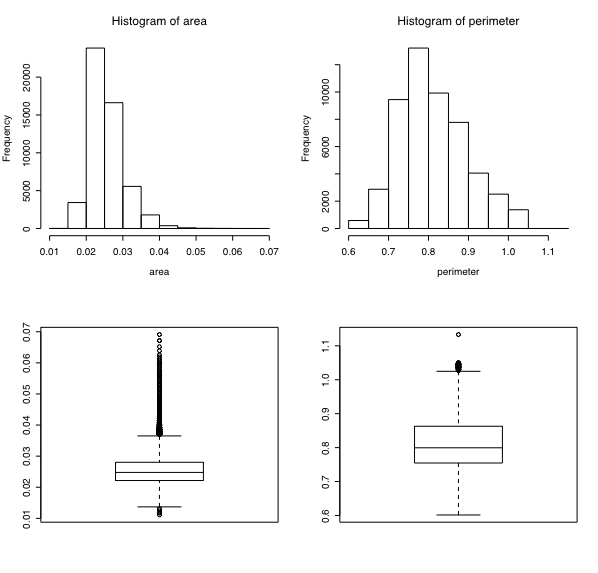
I have been investigating issues of ovule and seed development recently. One question that has come up is: How much variation is there in seed size? I had analysed some seed set data for some earlier work with some image analysis software. Consequently I have a large data set of seed area and perimeter for Chamerion angustifolium. A rough look at the data is:
The data set is available as seedSizeData.txt.zip. Bewarned, the file contains over 100,000 lines – be sure to use an efficient text editor or stats package. All dimensions are in cm. The seed? column contains a 1 for seeds and 2 for objects smaller than seeds. See this for details.
The Ecological Detective by Ray Hilborn and Marc Mangel is an excellent source for learning how to analyse ecological data with sophistication. Traditionally, ecological data is analysed from the binary perspective of hypothesis testing. The goal of such testing is to either accept or reject a null hypothesis. Although it is well entrenched in ecological training and publication, this hypothesis testing has repeatedly been attacked by statisticians and many ecologists.
Without entering into this debate now, Hilborn and Mangel present an alternative of constructing models of the biological system of interest and then testing the model with collected data. This approach offers a much more nuanced and powerful way of understanding ecological processes. No longer is the ecology simply used to accept or reject a null hypothesis. Rather, a deeper understanding is required that leads to greater insights into the process.
In some recent research (http://public.me.com/mroutley/SIandDichogamy.pdf) I had to make inferences about families based on character states of the species within the family. One approach is to use a simple majority rule. For example, if more than half of the species possess character state x rather than y, then the family can be described as x. However, this approach seemed rather liberal, which led to a 2/3 majority criterion: if more than 2/3 of the species are x, the family is x; If less than 1/3 is x the family is y; otherwise the family is ambiguous.