Interesting read on the health effects of wind turbines, with a comparison to coal and nuclear http://bit.ly/S51fv (via @globeandmail)
Interesting read on the health effects of wind turbines, with a comparison to coal and nuclear http://bit.ly/S51fv (via @globeandmail)
Family stroll around the neighbourhood. Quite nice outside, if somewhat chilly.
Property rights: the Nisga’a pave the way
www.theglobeandmail.com/news/opin…
Engaging in commercial activity doesn’t make someone less indigenous
Restarting Apple Mail fixes my Notes synchronization problem with the iPhone. Repeat every couple of days.
Replaced stolen electric mower with a manual reel mower. Requires a bit more effort, but works quite well and is much quieter.
Lounging by the kiddie pool after a walk through the park.
Registered for Toronto Hydro’s peaksaver program. My air conditioner is going to join the semi-smart grid and reduce peak load.
http://www.gigatonthrowdown.org/ identifies building efficiency as the lowest cost pathway to achieve 1-gigaton CO2e reduction by 2020.
Bizarre. Someone broke into our garage & stole the landmower, leaving behind more valuable things. Didn’t even take the electrical cord.
Discomfort of my recent capitulation to IT was greatly reduced by #GTD guide to Outlook 2003. Saved hours of fiddling. http://bit.ly/GyObv
Instapaper Pro 2.0 released!
Excellent. This is one of my top three iPhone Apps and these look like important changes.
Looks like an interesting article on data mashups in R: http://bit.ly/IEyg9 Could be a good excuse to use R at work (via @timoreilly)
The CaGBC maintains a list of all the registered LEED projects in Canada. This is a great resource, but rather awkward for analyses. I’ve copied these data into a DabbleDB application with some of the maps and tabulations that I frequently need to reference.
Here for example is a map of the density of LEED projects in each province. While here is a rather detailed view of the kinds of projects across provinces. There are several other views available. Are there any others that might be useful?
Playing with a dump truck (via Flickr)

Perhaps my last academic paper? Two manuscripts and several datasets left, but no resources to do anything with them.
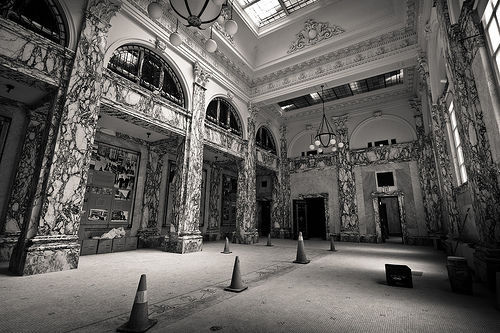
I’ve been curious about this abandoned bank on Yonge Street. Jonathan Castellino has some great pictures of the interior. (via jonathancastellino)
I was given an opportunity to propose a measure to clarify how and on what basis the federal government allocates funds to STI - a measure that would strengthen relations between the federal government and the STI community by eliminating misunderstandings and suspicions on this point. In short, my proposal was that Ottawa direct its Science, Technology and Innovation Council to do three things:
To provide an up-to-date description of how these allocation decisions have been made in the past;
To identify the principles and sources of advice on which such decisions should be based;
To recommend the most appropriate structure and process - one characterized by transparency and openness - for making these decisions in the future.
These are reasonable suggestions from Preston Manning: be clear about why and how the Federal government funds science and technology.
Of course I may not agree with the actual decisions made through such a process, but at least I would know why the decisions were made. The current process is far too opaque and confused for such critical investment decisions.
I was given an opportunity to propose a measure to clarify how and on what basis the federal government allocates funds to STI - a measure that would strengthen relations between the federal government and the STI community by eliminating misunderstandings and suspicions on this point. In short, my proposal was that Ottawa direct its Science, Technology and Innovation Council to do three things:
To provide an up-to-date description of how these allocation decisions have been made in the past;
To identify the principles and sources of advice on which such decisions should be based;
To recommend the most appropriate structure and process - one characterized by transparency and openness - for making these decisions in the future.
These are reasonable suggestions from Preston Manning: be clear about why and how the Federal government funds science and technology.
Of course I may not agree with the actual decisions made through such a process, but at least I would know why the decisions were made. The current process is far too opaque and confused for such critical investment decisions.
The kids have a great time together, which is fantastic.

TheStar.com | World-beating bureaucrats
My research compared the achievements of Canadian public service and political leaders with their U.K. counterparts, and the results are very favourable to Canada. It was rewarding to hear so many U.K. public service leaders ask about Canadian reforms. It seems that public service managers around the world are looking carefully at leading practices emerging in Ottawa and the provinces, especially Ontario.
One of the strange challenges I have as a public servant is the constant description of my colleagues as overpaid and underworked. The classic quote came from John Tory as leader of Ontario’s opposition party:
“These kinds of jobs are people who are breathing each other’s exhaust and sitting around, analyzing each other’s papers. There hasn’t been enough attention paid to looking at whether those people are really making a productive contribution to the effective delivery of public services in Ontario.”
Of course, you can point to several studies showing how efficient Ontario’s public servants are and how much the public benefits from government services, but people aren’t interested in reviewing this kind of evidence. So, I’m happy to see Tony Dean advocating for public servants. I think that strong advocacy from public servant leaders will help much more than statistics.